













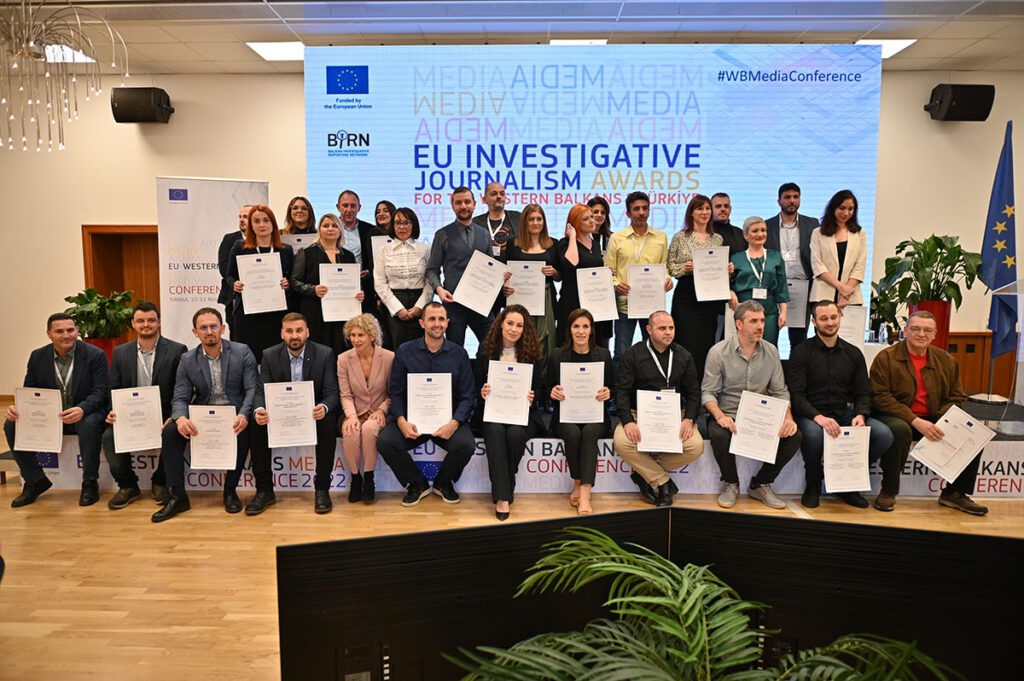
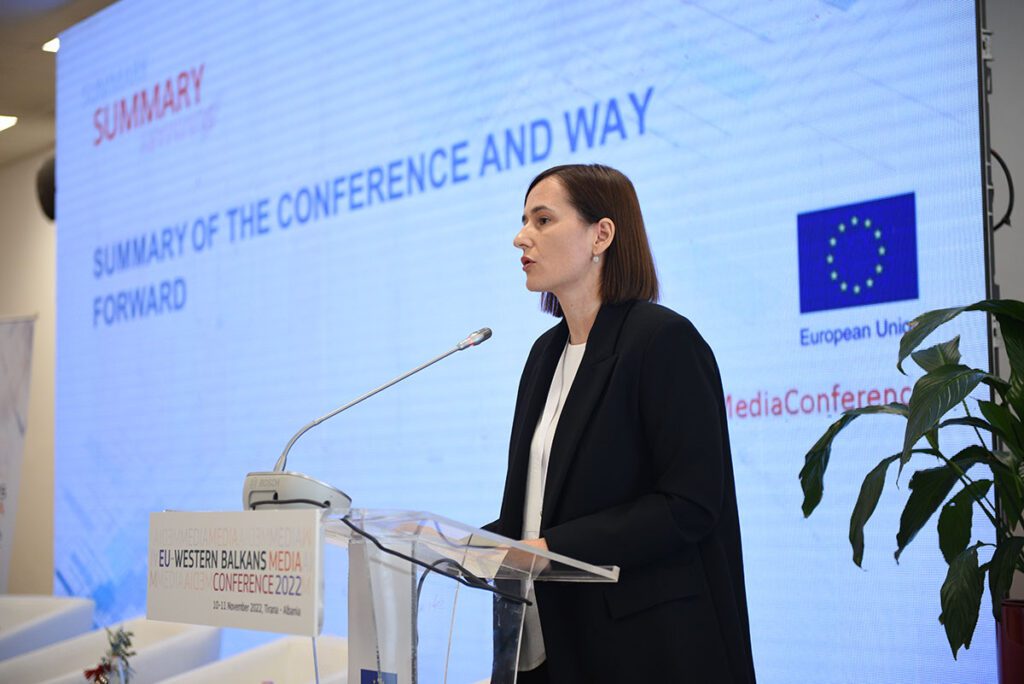
#WBMediaConference
Freedom of expression and media freedom are at the heart of the European Union and are essential in its relations with the Western Balkans. They are among the fundamentals of the EU enlargement policy. The European Commission 2022 enlargement package issued on 12 October highlighted that freedom of expression, media freedom and pluralism are key pillars of a democratic society and must be upheld. The lack of progress in this area is among the reasons why the EU developed dialogue and engagement with media community in the Western Balkans. This effort includes a series of dedicated media freedom and media development focussed events and conferences.
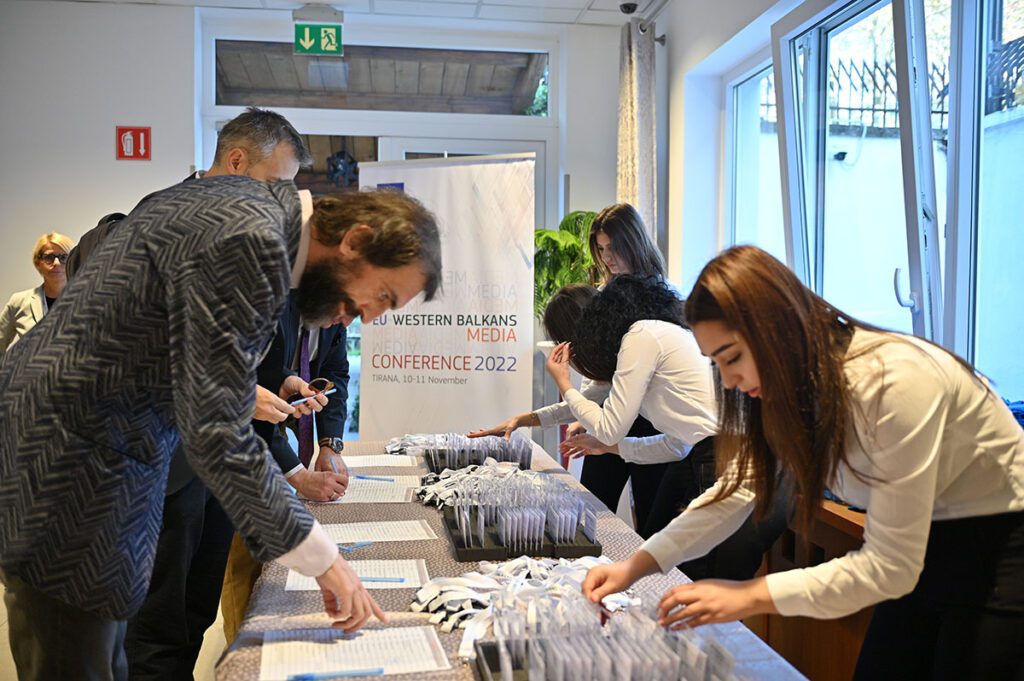
Now, after the lifting of pandemic-related restrictions, the European Commission and the European External Action Service are continuing this important dialogue and exchange, bringing back people in person together, enabling vivid discussions and exchanges, by organising the 2022 EU-WB Media Conference. This will be an opportunity for EU media specialists and partners from the Western Balkans media community to meet.
The event will address the key challenges related to media freedom, protection of journalists and issues related to contamination of the information environment, including information manipulation, foreign interference, and disinformation. These topics are especially important in the context of Russia’s aggression against Ukraine.
The conference will gather around 180 participants from the Western Balkans and the European Union and will allow an open discussion on the challenges that the journalists and media professionals in the Western Balkans are facing: media development trends, changing information-gathering patterns, and new trends in countering information manipulation and foreign interference.
DAY 1
10 NOVEMBER 2022
Detailed Programme
DAY 2
11 NOVEMBER 2022
Detailed Programme
Rapporteur : Ms Blerjana Bino, Communication expert, Director of Centre Science and Innovation for Development
Michela Matuella, Acting Director Western Balkans, Directorate-General for Neighbourhood and Enlargement Negotiations, European Commission
Upon invitation only
ROGNER HOTEL TIRANA
Bulevardi Deshmoret E Kombit
Tirana, Albania
Journalist
Olaf Bruns is a Brussels-based journalist. A former Deputy Head of the Brussels office of the international TV news broadcaster Euronews, he now works as a freelancer. Amongst others, he produces podcasts, writes for the European Green Journal, and is the Deputy Editor-in-Chief of the quarterly magazine Progressive Post. Olaf provides Media Training for NATO armed forces via Crown Media and teaches journalism at the Brussels-based media school IHECS. He holds a Master II Degree in Social Anthropology and Development Studies from Paris 1 Panthéon-Sorbonne University with several years of social science research work on armed conflicts in various African countries.
Tijana Cvjetićanin is a co-creator of two fact-checking platforms in Bosnia and Herzegovina: Istinomjer.ba (2010) and Raskrinkavanje.ba (2017). In 2018-2019 she was also the lead editor of ‘FemFacts’, an international fact-checking project focused on misinformation targeting women. Since 2019, Tijana has been a member of the Advisory board of the International Fact-Checking Network (IFCN) and has been a member of the working committee that is drafting a code of the future European Fact-Checking Standards Network (EFCSN) in 2022. Her other interests include social research, human rights, good governance and media analysis.
Director, Media and Journalism Research Center
Marius Dragomir is the Director of the Media and Journalism Research Center, an international think tank focused on the study of media, journalism, politics, and technology. He also teaches at Central European University (CEU) in Vienna. Dragomir led the global research and policy portfolio of the Programme on Independent Journalism (PIJ) of the Open Society Foundations (OSF) in London. He now leads several global comparative research projects including Media Influence Matrix, a global research project looking into power relations and undue influence in news media, and State Media Monitor, a project monitoring the key developments in state media in over 155 countries.
As the author of expert publications, he is specialised in media and communication regulation, digital media, governing structures of public service media and broadcasting, spectrum management, and ownership regulation.
Editor in chief, Faktisk.no.
In July 2017, Faktisk.no was launched as the first dedicated fact-checking organization in Norway. It is the result of a unique cooperation between six of the country’s largest and competing news organizations and broadcasters: Dagbladet, VG, NRK, TV 2, Amedia and Polaris Media.
As part of the founding project group, Kristoffer Egeberg became its first editor-in-chief. Before this, he was a long time investigative journalist in the Norwegian national daily Dagbladet, and a winner of Norway’s most prestigious journalism award, Skup (2014), and the IR-prize for international reporting (2015).
He is also an author, with his critically acclaimed documentary book «Fredsnasjonen Norge» (Norway, the nation of peace), about Norwegian foreign and defence policy since the Cold War.
Anne Katrine Førli, is born in Oslo, Norway. She has been working as a journalist, radio and tv-host, news editor, and debate editor for Radio and TV-debates in NRK, Norwegian Broadcasting Corporation for 26 years. She also worked with investigative journalism. She studied journalism, criminology and political science and graduated from University of Oslo and Høyskolen i Volda.
She is currently on of the editors of the NRK-program “Dagsnytt 18”, a daily live-show with guests discussing topics from the news.
Senior Programme Manager at the European Endowment for Democracy (EED)
Krenar Gashi is a Senior Programme Manager at the European Endowment for Democracy (EED) in Brussels, covering Albania, Kosovo and North Macedonia. A former journalist, activist and think tank executive, Gashi established media programmes and founded some of the most renowned civil society organisations in Kosovo. His expertise lies in democratisation, particularly in development of civil society and media. Gashi studied sociology, holds an MA in Media and Communication (KIJAC, Kosovo) and another one in European Politics (University of Sussex, UK). Prior to joining EED, he spent three years at Ghent University in Belgium, where he is PhD candidate in Political Science. His research interests are power and discourse, focused on the European Union and the Western Balkans.
Chief of Party, Balkan Media Assistance Program
Advisor for Western Balkans
Internews
More than 25 years of professional experience in the field of media development, freedom of expression, media legislation, investigative journalism, conflict-sensitive reporting, and reconciliation projects in post-conflict societies, transitional countries and emerging democracies. Chief of Party/Team Leader in seven complex projects so far. Working experience in 21 countries, with a focus on the Western Balkans region. Chief of Party for Internews’ USAID-funded Balkan Media Assistance Program covering Bosnia and Herzegovina, Kosovo, Montenegro, North Macedonia, and Serbia. As of 2017, Internews’ Advisor for Western Balkans.
More than 40 years of professional experience in media including: BBC World Service – Head of Croatian Service (2003-2007); Feral Tribune, senior columnist (1996-2001); Danas weekly, journalist, section editor, senior columnist (1982-1992), etc. More than thousand articles, interviews, and comments published.
Ervin Goci completed his studies in Philosophy at the University of Tirana, his postgraduate studies were oriented in Humanities, and then continued his doctoral studies in the Department of Journalism and Communication, Faculty of History and Philology, where he has been working since 2005’s. He has covered several disciplines as a university lecturer, such as communication theories, theories on public space and community engagement, public relations theories, and managerial models in new media. He has been part, regularly, in studies and scientific conferences of the Department of Journalism and Communication, offering his expertise in the conceptual phase of these projects. Lecturer Ervin Goci has extended the theoretical delivery beyond the university auditorium, covering a weekly column on national public television, on issues related to the relationship between the media and modern technologies, editing and producing news in the time of algorithms, building public opinion on the dynamics of networks social. Beyond university projects, Mr. Goci regularly engages in several research projects in partnership with organizations focused on issues of public sensitivity such as the environment, human rights, professional status of journalists, offering his expertise in moderating public communication of these agencies.
EU Ambassador, Head of the European Union Delegation to Albania
Since August 2022, Christiane Hohmann is the EU Ambassador, Head of the European Union Delegation to Albania. Prior to this appointment, Ambassador Hohmann was the Ambassador of Germany to Estonia. She previously served as the German Ambassador to Bosnia and Hercegovina in 2016-2019 and prior to that held various diplomatic positions in the US and the European Commission. A graduate of the Humboldt University – Berlin in English and French literature, Ambassador Hohmann joined the German Federal Foreign Office in 1991. She served at the German Embassy in the US from 1994-1997 as well as in 2010-2013 when she was Head of Division in the Political Department dealing with US domestic policy and Congressional relations. Between 2005-2010, Ambassador Hohmann worked for European Commission on US foreign policy, the Middle East and Russia as well as a spokesperson on External Relations and the European Neighbourhood Policy.
Having spent a substantial time with the Latvian diplomatic service – 1990-2004 (among the positions taken there – Ambassador to Germany, Chief negotiator for Latvia’s accession to the EU, Latvia’s Permanent Representative to the EU), Andris joined the European Commission as the Head of Cabinet of the Energy Commissioner Andris Piebalgs.
In 2010, he started to follow the files of the civil society and media freedom in the Directorate General for Enlargement, EC, as Principal Adviser. Andris conceptually developed a series of media freedom and development related conferences, such as Speak-up! and Western Balkan Media days, for the countries covered by the EU enlargement policy, and three Eastern Partnership Media conferences. Largely as a result of these forums, a number of specialised assistance programmes in media field were formulated and rolled out.
Senior Media Advisor, USAID
Shannon Maguire is a Senior Media Advisor at the USAID Bureau for Europe and Eurasia, where she manages several regional media support programs and advises USAID Missions in the region on bilateral media programming. Before joining USAID in 2015, Ms. Maguire worked for USAID/Rwanda and USAID/Bosnia-Herzegovina, as well as the Global Investigative Journalism Network and the National Endowment for Democracy. After serving as a Peace Corps Volunteer in Uzbekistan in 1999-2000, she earned her M.A. from Georgetown University’s School of Foreign Service in Russian and Eurasian Studies and B.A. in Political Science from the University of Mary Washington.
Co-founding Editor, Sbunker, Kosovo
Agon Maliqi is a political analyst and media writer from Kosovo, based in Tirana, Albania. He was the co-founder and until recently the Chairman of the Board of Sbunker – an Albanian-language commentary and analysis blog, as well as a think tank working on democracy and security issues in the Western Balkans. Mr. Maliqi currently works as an independent analyst and consultant on security, conflict and democratization issues in the Balkans and South Caucasus. Previously, Mr. Maliqi was a Reagan-Fascell Democracy Fellow at the National Endowment for Democracy (NED), as well as a Draper Hills Fellow at the Center on Democracy, Development, and the Rule of Law at Stanford University. He graduated in Political Science and European Studies from the American University in Bulgaria in 2006, and obtained a Master’s Degree in International Development Policy from Duke University (USA) in 2012.
Executive Director, International Press Institute
Frane Maroević is the Executive Director of the International Press Institute (IPI). Before joining the IPI in September 2022, his work at the Internet and Jurisdiction Policy Network and the Freedom Online Coalition Advisory Network focused on threats to online freedom of expression.
In post-war Bosnia and Herzegovina, he worked on the reform of public broadcasting, media regulation, and managed donor support for independent media. From 2015 to 2019, he was the Director of the Office of the OSCE Media Freedom Representative.
Acting Director Western Balkans, Director General for Neighbourhood and Enlargement Negotiations, European Commission
Michela Matuella is the Head of the Albania, North Macedonia Unit in the Directorate General for Neighbourhood and Enlargement negotiations of the European Commission since 2014 and Acting Director for the Western Balkans as of April 2021. She was previously member of the Cabinet of the Commissioner for Enlargement and Neighbourhood Policy (2012-2014), after having worked on the EU accession negotiations with Croatia (2009-2012) and Romania (2003-2005), as well on the negotiations for the Stabilisation and Association Agreement with Bosnia and Herzegovina (2005-2006). She has been chargé d’affaires of the EU Delegation in Eritrea, after several years of work in sub-Saharan Africa (Kenya, Lesotho, Somalia).
CRTA Program Director
Raša Nedeljkov, CRTA Program Director, has been engaged in the organization since 2013. He has been managing CRTA’s programs that focus on establishing mechanisms for citizen engagement in accountability oversight and advocacy, and raising demand for democracy in the country. He has extensive experience in civil society and political activism, and a strong background in analyzing trends related to media reporting about different political and foreign actors, the spread of disinformation in media and public sphere, as well as the provision of assessments related to the state of play of media, democratic institutions and level of citizens’ democratic engagement. Rasa has also been acting as a Chief of the CRTA’s election observation mission, responsible for the overall coordination and leadership of the mission’s teams and operations within monitoring of the election campaign and voting process during local, parliamentary and presidential elections in Serbia since 2016, as well as voting in the constitutional referendum in 2022.
Editor, 360 Degrees, North Macedonia
Vasko Popetrevski is the editor and the host of the popular Macedonian news show “360 Degrees” that combines investigative and debate/interview approach. With 20 years of working experience, he was an editor at various domestic media and news outlets in North Macedonia. He is a member of the Executive Board of the Helsinki Committee.
Team Leader, GIZ
Filip Radunović is working for the Gesellschaft für Internationale Zusammenarbeit (GIZ) based in Belgrade. Since spring 2022, he is the lead of the EU and German Government (Ministry for Economic Support and Development) co-funded programme “Support to Media Freedom and Pluralism in the Western Balkans”. He studied communication and media science and political science at the University of Vienna, where he researched the media effects and semiotics, earning his PhD in 2007. In his previous positions with? GIZ, he worked on supporting the EU integration process of the Western Balkans and the establishment of the Regional Youth Cooperation Office (RYCO). During his prior engagement with ERSTE Foundation in Vienna (2008-2016), his portfolio encompassed topics of democratization, migration, political education, arts, and culture in Central and Southeast Europe.
Regional Director, Balkan Investigative Reporting Network (BIRN)
Marija Ristic is the executive director of Balkan Investigative Reporting Network, a network of seven non-governmental organisations promoting freedom of speech, human rights and democratic values in Southeast and Central Europe. Ristic oversees the activities and communications within the Network and represents it publicly.
Senior Programme Manager for Western Balkans, European Endowment for Democracy
Marija Sosic is a Senior Programme Manager for Western Balkans in the European Endowment for Democracy (EED). She has been with EED from the very beginning of its Western Balkans programme launched in 2018 that provides support to independent media and civic actors. She was previously engaged on various capacity-building programmes for civil society and public administration in the region, funded by the European Commission and Austrian Development Agency, German, Swiss and French development aid, and other donors. Before joining EED in Brussels, she worked in Austria, Montenegro, North Macedonia and Serbia.
Danish journalist
Kurt Strand, born in Copenhagen in 1955, is an experienced Danish journalist, anchoring and producing radio and television broadcasts for more than 35 years. He has been working with news and current affairs in several formats at DR, Danish Broadcasting Corporation 1985-2010. Since then, he has been working as independent journalist, anchoring formats on media criticism at “Presselogen” (The Press Council) TV2 News and “Mennesker og medier” (People and media) DR-P1. For more than 30 years, he has done courses and coaching sessions on interviewing, storytelling and debating skills. In the period 2021-2022, he served as fellow at the Constructive Institute, University of Aarhus, researching and developing new formats and tools for public debates.
Executive Director of BIRN Albania
Kristina Voko is the executive director of BIRN Albania from 2014 and coordinates the network’s activities, fundraising and projects in the office in Tirana. During her professional experience with BIRN, she has been involved in designing and implementing projects and research studies related to journalism, disinformation, right to information, media freedom, anti-corruption, open data and transparency initiatives. Before joining BIRN, she has been engaged in coordinating and managing different projects for national and international organizations, concerning the development of policies and regulatory framework on disability; promotion of human rights and social inclusion through the empowerment of individuals and associations; training of health professionals, teachers and other actors; promotional activities for vulnerable communities; etc.
Founder and Editor-in-Chief of Oblakoder magazine
Marina Zec is the founder and Editor-in-Chief of Oblakoder magazine, an online media magazine founded by young journalists with an aim to inform, educate and empower young people in the Western Balkans. Because of the lack of media outlets that provide content for young people in Serbia, and in order to change the way young people are portrayed in the Serbian media, Oblakoder was founded as a contemporary media outlet that shares the stories of young people, activists, artists, and cultural workers.
Marina Zec is also a PhD student and media researcher at the Faculty of Dramatic Arts, University of Arts in Belgrade, in the field of media management. Her goal is to contribute to creating innovative media content that matches the contemporary life of young people in Serbia, and to, with her scientific work, explore the effects of social media and new media trends on the media habits of young people.
Association “Center for Media Development and Analysis” / Online magazine Žurnal, Bosnia and Herzegovina
Slobodan Golubović is the Programme Coordinator and Editor for data selection and processing at the Center for Media Development and Analysis (CRMA). CRMA is the founder of the Online magazine Zurnal.info, the first online magazine in Bosnia and Herzegovina dedicated to fight against corruption, and the portal PratimoTendere.ba, the first portal for monitoring risks in public procurement in Bosnia and Herzegovina. To date, CRMA has implemented a wide range of projects in the areas of media production, information and communications, networking, lobbying and advocacy. Slobodan has been working in the media and NGOs since 2017.
John Hooper has been a foreign correspondent for over 30 years and has reported from more than 50 countries for, among others, the BBC, Reuters, the Guardian, the Observer and the Wall Street Journal. He is currently The Economist’s Italy and Vatican correspondent.
His book, The Spaniards: A portrait of the new Spain, won the 1987 Allen Lane award for a best first work of history or literature. He later published two expanded and revised versions under the title of The New Spaniards. His The Italians, published in 2015, has been a bestseller on both sides of the Atlantic. From 2017 to 2022 Hooper was a lecturer at Stanford University’s campus in Florence. He is an honorary fellow of St Catharine’s College, Cambridge.
Programme Director, The Common Voice for Media Freedom, Serbia
Svetlana Kojanović is the Director at the Centre for Monitoring and Activism, as well as a Member of the Board of Directors of Association of Independent Electronic Media (ANEM). She is one of the people behind the Common Voice for Media Freedom, the initiative of the local media outlets realised with the support of European Endowment for Democracy.
She has over 20 years of experience as editor-in-chief in regional media in Serbia as well as a foreign correspondent. For more than 10 years, she worked as a trainer for news production in local media. In addition, she is the founder of the first civil society media in western Serbia.
Program Director of the Center for Democratic Transition (CDT)
Milica Kovačević, Program Director of the Center for Democratic Transition (CDT), coordinates organization’s Democratic Citizenship programs, dealing with the radicalization, disinformation and malign foreign influences. She has been active in the civil society in Montenegro for over two decades. Her expertise includes elections, policy analysis, foreign and security policy. She participated in numerous research projects that analyzed Russian and Chinese soft and sharp power and the influence of corrosive capital in the Western Balkans. Since 2018, as part of Raskrinkavanje.me team she analyzes disinformation and propaganda, with focus on foreign affairs and security.
Editor-in-Chief of Unbias the News
Christina Lee is the Editor-in-Chief of Unbias the News, a feminist cross-border newsroom started by Hostwriter, a network that helps journalists to collaborate easily across borders. Based in Berlin, Germany, she has worked in multiple human rights and journalism projects across Europe, and hosts a monthly radio show on politics. She holds an LLM in International Law and International Relations from the University of Kent, a Juris Doctor from the Catholic University of America, and a Bachelor of Arts from Agnes Scott College.
Ana Petrusheva is an experienced journalist and one of the founders of the BIRN regional network and BIRN Macedonia.
As the country director of BIRN Macedonia, she organises editorial, trainings and debates involving journalists throughout the country, and secures funding for the organisation. She was managing editor of BIRN’s flagship English language publication Balkan Insight from 2006 to 2016.
Prior to joining BIRN, Ana was the Macedonia country director for the Institute for War and Peace Reporting, IWPR. She previously worked as a journalist for a variety of media outlets in Macedonia and abroad, including Reuters, Deutsche Welle, Telma TV and daily newspaper Dnevnik.
Ana was the associate producer of the IWPR documentary , “Ohrid and Beyond,” and served as the co-author and producer of the BIRN Kosovo documentary, “Does Anyone Have a Plan?”
Ana graduated from the Skopje Journalism School in the Faculty of Law at the University of St. Cyril and Methodius.
Founder and Executive Director of Lie Detectors
Juliane von Reppert-Bismarck is the founder and Executive Director of Lie Detectors, an award-winning and journalist-led news-literacy organisation raising awareness of disinformation and media bias among schoolchildren and teachers. She directs Lie Detectors’ development and strategy and designed its concept and training approach. Juliane advises national and international institutions on anti-radicalisation and literacy in an age of media pluralism, including within the European Commission’s High Level Expert Group on Digital Disinformation and Fake News and Expert Group on Tackling Disinformation and Promoting Digital Literacy through Education and Training on behalf of Lie Detectors. To create Lie Detectors, Juliane put aside an award-winning journalism career, during which she wrote for The Wall Street Journal, Newsweek, Reuters, MLex and Spiegel Online among others, reporting from Europe and the US as well as from sub-Saharan Africa, the Middle East and Arctic. She is an alumna of New York City’s Columbia University Graduate School of Journalism and the University of Edinburgh and speaks German, English, Spanish and French.
Funtion
Lorem ipsum dolor sit amet, consectetur adipiscing elit. Ut elit tellus, luctus nec ullamcorper mattis, pulvinar dapibus leo. Lorem ipsum dolor sit amet, consectetur adipiscing elit. Ut elit tellus, luctus nec ullamcorper mattis, pulvinar dapibus leo.
Lorem ipsum dolor sit amet, consectetur adipiscing elit. Ut elit tellus, luctus nec ullamcorper mattis, pulvinar dapibus leo.